Chapter-18
Reminiscing old memories
Life brings melancholy, mirth and memories. The tears dry up, the smiles fade out but the memories endure for ever . No matter how old the memories are we nourish them so long as we live. The best thing about memories is to cherish them and relive them. As the age advances people tend to be nostalgic and develop wistful desire or sentimental yearning to return in thought to a former time in one’s life . They also step in at a particular place, visited in earlier life, to retrieve old memories not recalled for many years. They start reminiscing about the locations they have been before years back and look at them in a different perspective now that they did back then.
Immortalizing the past through written words, watching old black & white movies, listening to old music, sifting through creased, faded, torn black & white photographs shot with obsolete technology and revived through scanning and digitization ,can also be strong triggers of nostalgia. Sharing of messages on the social media also helps one to relive the memories of time spent and the values learnt from the loved ones. Experiencing nostalgia has physical and psychological benefits. It can result in increased optimism, inspiration, boosted self-esteem and feeling of purpose but it may also contain element of sadness. Why can nostalgia be so comforting and also so unsettling? The answer is complex, but so is nostalgia which is powerful and sometimes difficult to avoid.
Old friends are the great blessing of one’s later years. They have a memory of shared platforms, identical work culture and thinking disposition. No distance of place or lapse of time can mitigate the friendship of those who are thoroughly conditioned of each other’s worth. Get-together is one way not to allow friendships slip away. All said and done, meeting new people and visiting new places should also be looked for to create new memories.
Reminiscing the past through get-together of our batch - First of November every year is observed as IRSE day on the Indian railways. For the year 2012 IRSE day of Patna chapter was celebrated in the premises of Maurya hotel. The IRSE fraternity of East Central Railway remembered me.

I was happy to participate in the function. In the capacity of the oldest member I was presented a shawl by my ex colleague Sri G.S.Tewary, then Chief Administrative Officer (Con). Another such occasion was a get-together in the premises of the Railway club at Mahendru ghat on the eve of superannuation of the GM Sri Madhuresh Kumar. It was a memorable occasion as Sri Madhuresh happened to be my ex colleague.

Shortly after our first get-together in 2004 Dr Mani, who was instrumental in bringing us together, contracted a terminal disease from which he could not recover. Sadly, we lost him but the spirit he kindled survived. Sri M.P.Monga became the new torch-bearer of our batch and the yearly meet continued under his initiative. After a long gap I attended the get-together at Delhi in October 2018.

It was a disappointment to find that the participation was low. Even all those who lived at Delhi did not show up for multiple reasons. In the wake of Corona pandemic, a virtual meet was organized through video conferencing on 5th October 2020.

Dwarka (April 2008)--We were putting up at Rajkot where our son-in-law was posted. One day I visited the DRM office and met the concerned engineering official requesting him for arranging rest house accommodation at Dwarka. It was an overnight journey from Rajkot

With the courtesy of Rajkot division I was comfortable in the rest house near Dwarka railway station.


The Dwarkadheesh shrine located at the cusp of Gomti river and Arabian sea has its own charm and history. Lord Krishna is worshipped here in the name of Dwarkadheesh. We approached the spiritual site through the north entrance (Moksha Dwar). The premises was unimpressive and uninviting. The south entrance (Swarg Dwar) is from the Gomti ghat side after ascending 56 steps. This is ideal for a panoramic view of the Gomti river and the Arabian sea as also for a photograph with the temple in the background. On the top of the temple there is a long flagstaff. The fabulous fluttering flag thereon is changed 5 of times a day amidst scenes of singing and dancing by the sponsor, his family members and near ones. The shringar (ornamentation) of the Deity is changed all through the day.
 Immortalizing the past through visit to Baraon (May 2009)-- The old Piro station of the narrow gauge line was close to the Ara-Sasaram state highway but the new Piro station of the broad gauge line is about 1 km away from it and the approach from the State highway is through a circuitous route. On the occasion of commissioning of Piro-Sasaram section in November 2008 an authoritative source had announced that rake unloading facility would be developed at this station. But it remained a paper promise.
Located at about 3 kms from Piro town, Baraon is the village where my Nana once lived. In my living memory I had been to this place somewhere in late forty and a fresh visit was overdue. This was made possible with the courtesy of my cousin brother who still maintained link with this place and took care that the ancestral house survived. My emotions cascaded to glance at the corners of the house where my affectionate Mother once lived in the company of her siblings and Parents. There was hardly anything to fix the time and arrest the fading memory except the pond in front of the house and the public patio in the rear . The neighbours on knowing our identity greeted us warmly.
Muzaffarpur Institute of Technology (April 2010)- It was my Alma Mater. After leaving the college in 1960 I had set my feet in its sacred premises in 1979 on the occasion of the Silver Jubilee. Another trip was overdue which materialized in April 2010 with the courtesy of Sri Madhuresh Kumar. He was also a product of this college, then posted as Chief Administrative Officer/E.C.Rly, Mahendru ghat Patna.

In was an unannounced visit. We captured scenes of the college building, the class rooms, the hostel and the garden, taking care to see that it remained un unnoticed affair.
Shri Jagannath Puri temple (February 2011)- At Puri we put up in the Railway rest house. A railway staff was made available to us to facilitate visit to this holy Dham.
In the massive shrine Lord Jagannath, Balbhadra and Subhadra, a trio of deities, are worshipped. Unlike stone and metal the deities are made of wood and are ceremoniously replaced by an exact replica in the 8th or 12th or 19th year of the last replacement. The year chosen is such that it has an extra month according to Hindu calendar. Every day a
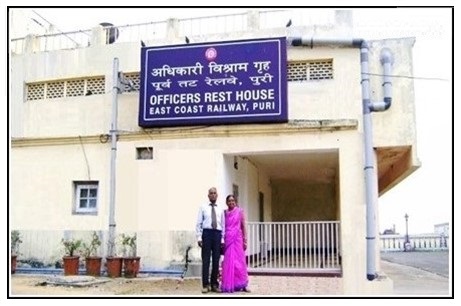 priest gets on to the top of the temple to change the flag. In the Annual Rath Yatra the Principal deities adore an elaborately decorated Rath which is pulled by enthusiastic devotees watched by thousands. For sighting the deities we opted for a close view by purchasing tickets. The nearby sea beach was too crowded and unclean. We had last visited this place with the children in June 1986 and had stayed in the same Rest house. There is a railway heritage hotel also next to the Rest house called BNR hotel after the old name of Bengal Nagpur Railway.

Konark sun temple (February 2011)- From Puri we travelled by road to Konark 35 kms away. Konark temple is dedicated to Sun God. The main temple with its Shikhar (curvilinear tower) rising much higher than that of the adjacent Mandapa (assembly hall), and its Sanctum have become extant. But the shell of its Mandap filled with sand remains. This too was under threat of decay but it was saved by the conservation efforts of the British India archeological team. A plaque provided on its wall reads “To preserve this superb specimen of old Indian architecture the interior was filled in by the order of Lieutenant Governor of Bengal. A.D.1903.” The Mandapa has door on all the four sides which are aligned with the movement of sun. Sunlight enters the front and back doors during Vernal equinox (20th March) and Autumnal equinox (23rd September). Similar phenomenon occurs at the two side doors during summer solstice (21st June ) and the winter solstice (21st December).

Much of the temple complex is in ruins. What survives has the appearance of the Mandap on a colossal chariot with twelve pairs of lavishly ornamented wheels drawn by seven richly caparisoned spirited horses and the Natya Mandap (Dance hall) in front of the temple. The structures and the elements that remain are astonishing for their intricate artwork, myriad themes, superb carving of divine, semi-divine and human figures amongst floral and geometric motifs embellishment. The temple is elegant even in its ruin. The lush green garden in front of the temple has been maintained with care. Konark Sun temple wheel features on the reverse side of the Indian currency note of Rs 20 to signify its value to Indian cultural heritage.
Nalanda & Rajgir (March 2011)- We had visited these places long back. It was time to revive their memory. This time the journey was accomplished by road. With the courtesy of my erstwhile colleague on E.C.Rly we could avail the facility of the railway rest house close to Rajgir station. Nalanda university was resurrected in the year 2010 as a successor to the ‘Nalanda Mahavihara’. It is located at Rajgir 12 kms away from the ruins of its namesake-considered to be among the greatest centres of learning in all of antiquity. There is a surreal sequel to its destruction. Prince Wangchuk of Bhutan who visited this place on 1st January 2017 in the company of his relatives at the age of 3 claimed rebirth in Bhutan Royal family , a reincarnation of the Nalanda university professor Virochna after 824 years . He narrated how the memories of his new birth are linked to the ruins. It is not possible endorse the words of the child but his aplomb and spirited facial expression seemed to baffle science which has yet to substantiate reincarnation.
Rajgir has come as an important pilgrimage for Budhists. There are some ravishing Hindu & Jain temples also for attracting devotees of these faiths. It has also developed as health and winter resort because of its warm water pond and calm & scenic Ghora-Katora lake. The added attraction is the chair-lift ropeway which takes one to Vishwa Shanti Stupa and monasteries ( at 400m height) built by Japanese devotees on the top of Ratnagiri hills. The scenic view from the top is divine. The chairs are so fashioned as not to inflict indignity on noble hills.


A state of the art glass-sky-walk suspension bridge 130 ft long was built of transparent-glass & steel at foothills of Vaibhar Giri and Swarna Giri near the main entrance of the Safari in 2021. Walking over it at a height of 250 ft from the valley and pleasuring in dizzying views is a rewarding experience.
Walking in Budha’s steps- With the objective of facilitating transport of coal from Koderma (on GC section) to the thermal power plant at Barh ( on the Main Line) two projects were sanctioned:-
Koderma-Tilaiya (a station on Kiul-Gaya line) rail line- The work is in progress.
Tilaiya-Rajgir rail line- It was commissioned in 2010. Jethian station on this line has a religious significance. Jethian valley contains what is believed to be one of the main routes taken by Budha during his 45 years of wandering and preaching at various places. After getting the news about Budha’s arrival the king Bimbisar with his retinue of ministers and a myriad followers proceeded from Rajgir to Jethian to greet Budha and escort him to Rajgir where the king would gift him his favourite pleasure garden “ Venu Vana”. The “Budha path” was conceptualized on the basis of travelogues of the Chinese monk-scholar Xuan Zang who visited this area in the 7th century AD. He had spent almost 2 years here with an eminent monk Jaydeva and wrote extensively about many spots associated with Budha. Alexander Cunningham identified this site in 1871. Systematic excavation of the ruins by the ASI did not begin until 1915 and ended in 1937. The second round of excavation and restoration took place between 1974 and 1982.
In the year 2014 a spiritual walk from Jethian to Rajgir (13 kms) was organized by several Budhist organizations to revive and spread the history of this valley in which above 1000 Budhist devout did the walk on the actual path taken by Budha in the sixth century B.C . The streets were embellished in bright chalk patterns to welcome the pilgrims. Every house that lined the main street had family members serving foods to the participants. The walk concluded in “ Venu Vana” ( bamboos grove) near the hot springs.
Retrieving old memories through visit to Chakia (July 2011)- It was a block headquarters in Champaran district where my Uncle was posted as the medical officer of the district board dispensary. Situated on Muzaffarpur-Motihari section of the N.E.Rly the place was known for its sugar mill of British era and its proximity to Kesaria Stupa, a Budhist pilgrimage site. But for me it has another dimension in that it is my birthplace.

By the time I joined MIT, Muzaffarpur, Uncle had vacated the doctor’s quarters in the hospital premises but I visited the complex a number of times reliving the sweet memories of the house where I first saw light of the world, the dispensary, the warning sign of the manned level crossing no 137 at the adjacent road and the neighbouring middle school. Time rolled on. Affectionate Uncle & Aunt had bade goodbye to this world leaving their house on Kesaria road to the care of their son. When I visited this place after a long gap in July 2011 the hospital complex had undergone transformation beyond recognition. Much to my dismay I found no trace of the memorable doctor’s quarters, the adjacent compounder’s quarters and a part of the dispensary. They were effaced to make room for a referral hospital. Chakia had acquired the status of a subdivisional town. Its iconic sugar mill was closed. The metre gauge line was converted to broad gauge with colour light signals in place of our cherished semaphore signals.
Rameshwaram (July 2011)- It is a quiet town on Pamban island connected with the Indian mainland by a road bridge and a nearly 2 km long rail bridge provided with a double leaf bascule which can be raised for passage of ships. The rail bridge , which stood battering of the cyclone in 1964 and celebrated its centenary in 2014 is an engineering marvel. Train moves over it close to the turquoise blue sea water which is exhilarating. The railway now proposes to replace this bridge by a new higher level bridge, which instead of bascules will have a vertical lift navigational span in the middle. With the courtesy of the Southern Railway engineers an IOW attended us on arrival of the train at Rameshwaram station and guided us to the Railway rest house on the first floor of the station building.

The temple is architecturally appealing. It is customary to take a bath in the nearby sea before entering the temple. The principal deity is ShivaLinga made by Sita using coastal sand and installed by Rama inside the shrine. My wife had brought ‘Gangajal’ for oblation to the deity and the programme was so designed that we visited the temple on a Monday of Sawan month. Presence of the IOW was a great help to us. After ‘darshan’ we spent time on admiring the magnificence of the corridors where the photography was not prohibited. The ornate third and the outer corridor is borne on 1212 pillars. Believed to be the longest in the world its sublimity impels admiration and reverence.

Dhanushkodi (July 2011)- From Rameshwaram we set forth in a car but on the approach of the town the metalled road ended and further journey was performed in a pick-up. It was a bumpy ride on muddy track and shallow water. Near the end of the land strip we alighted from the van. Pilgrims were taking holy dip in the sea, performing religious rituals , taking selfies amidst the ruins and shopping at the shell-shops. Wind was sweeping us . An eerie stillness pervaded the surrounding . The island compels our attention with its stunning seascape laced by two oceans namely the Bay of Bengal and the Indian ocean. At the same time one wonders as to how such peace and tranquility can at times also unleash ferocity and devastation. We feared that a fierce sea wave would appear any moment and sweep us away. Nothing happened.

Dhanushkodi was once a flourishing trade hub with a rail link to Pamban junction through a metre gauge branch line. Before its devastation the metre gauge rail line from Madras Egmore to Dhanushkodi boasted of ‘Dhanushkodi boat mail’ which ended at the pier from where there was a ferry service for transport of passengers to Talaimanar in SriLanka.
A severe cyclone hit the inland in 1964 wiping out almost all the traces of human settlements and engulfing a passenger train also. All that remains of this bustling ferry town and pilgrim centre are fragmented and wind swept wreckage of a few buildings on a sandy strip 600m long and 150m wide. Life, however still goes on for the small section of the fishfolk who continue to inhabit the harbour area that once provided a sea-link to SriLanka. The railway line from Pamban was also destroyed in the cyclone and abandoned. The place was declared unfit for habitation and is a ghost town. Although devoid of inhabitants it remains a tourist attraction due to its historical and mythological relevance. A proposal for construction of an 18 kms long railway line from Rameswaram to Dhanushkodi as well as restoration of the infrastructure destroyed during cyclone is on the anvil. Dhanushkodi would witness a substantial rise in footfalls once the railway connection is established.
It is said that till 15th century the Ramsetu connecting this place to Mannar island of Srilanka, about 50 kms away, was passable on foot but then a storm deepened the channel.
Haridwar and Rishikesh (November 2011)—This time we proceeded to Haridwar in a car from Delhi passing through Roorkee. We had put up at the guest house of the Patanjali Yogpeeth . Situated on the Delhi-Haridwar highway about 20 kms before Haridwar the Yogpeeth focusses on yoga practice & research, ayurvedic medicines & medical aid. The entire complex was well laid out ,neat and clean. There were restaurants and stalls. The room charge was moderate.
The evening was set apart for ‘Har ki Paudi ‘ which is the centre of People’s faith and devotion. This ghat is situated on the western bank of an escape channel of Ganga. For annual maintenance this channel is closed once a year between Dussehra and Diwali exposing large amount of trash & filth in the form of flowers, garlands, nuts, coins, currency notes and used clothes etc left behind by the impudent devotees. But this leads to a problem. When this channel is blocked the water level at Har ki Paudi depletes creating difficulties for the devotees eager to have a holy dip. But it is also the occasion for the local people to dig the dry channel bed in search of coins and other articles of value such as metal statues and utensils. While this period provides livelihood to hundreds of people the closure also results in less turnout of pilgrims and tourists which make the priests and shopkeepers an unhappy lot.

The next day was devoted to Rishikesh whose iconic landmark is Lakshaman Jhula. From the plaques fixed on its western side it was learnt that this 450 feet long and 6 feet wide suspension bridge was opened on 11th April 1930 in replacement of the 284 feet long old suspension bridge situated 200 feet on the downstream. During the devastating floods of October 1924 the old abutment was severely undermined and the bridge had to be abandoned.

While spending time in the premises of Lakshaman Jhula I noticed the foreign tourists were mostly talking of Madhuban Ashram a couple of kms away.
RVNL is proud to be tasked with construction of new Railway line from Rishikesh to Karnaparyag (125 kms) in Uttarakhand. This new line will be a game changer for this state as this will be the first time when a railway line will go into the hinterland. The objective of providing rail link between these two places is to facilitate easy access to the pilgrimage centres in the state of Uttarakhand, connecting new trade centres, development of backward areas and to serve the population living in the area. It is an ambitious project which may still take a decade to fructify.
Somnath temple (January 2013)- It was a road journey from Rajkot. The complex has a wide entry area. Situated on the west coast of Gujrat Somnath is an important pilgrimage centre and a tourist spot. The temple was reconstructed several times in the past after repeated destruction by invaders and the rulers. The restoration work of the present temple started with the resolve of Sardar Ballabh Bhai Patel, then home minister who was deeply moved to see the temple in ruins during his visit in November 1947. Despite opposition from the Prime minister JawaharLal Nehru the reconstruction was completed after Sri Patel’s death and the temple inaugurated by the President Dr Rajendra Prasad in 1951. The edifice houses Aadi Jyotirling Shri Somnath Mahadev. It also commemorates the sacred soil from where Lord Krishna took his last journey to Neejdham.

There is a Bana Stambha (arrow pillar) erected on the sea protection wall which bears a Sanskrit shloka signifying that there is no hindrance in the straight line from this point to the south pole. It is indicator of the ancient India wisdom. The pilgrims get ethereal experience in the backdrop of the magnificent temple and the holy waves sound of the ocean.
Construction of Rail-cum-road bridge over Ganga at Digha ghat, Patna- Though sanctioned in earlier years its physical construction had started in the year 2003 as a rail bridge. Its scope was enlarged as Rail-cum-road bridge in 2006. With the courtesy of the Chief Engineer (Ganga bridge construction) and the GM/IRCON/Ganga bridge, I had a chance to see the prestigious railway project on 20th November 2013. In view of large khadir width of the river Guide bunds on both the banks have been designed. The one on the Patna side serves the dual purpose of reducing the bridge length as well as protecting the Patna bank from possible erosion. Both the guide bunds ie on Patna side and Sonepur side were completed .The substructure was also ready to receive the girders which were in the process of assembly and erection by Cantilever method. The bridge to consist of 36 spans of 123m plus shore spans was destined to be the longest one (4.56 kms) in our country.


After anchor span is completed the link members are fixed to start the next span erection. Notice the dark-coloured link member fixing the top chord of the anchor span in rear with that of the span under erection. The link members, the link plates and the link bolts are all made with the highest precision. The cranes are secured to the top chord. The members are erected in a particular sequence and are temporarily supported by hanging. The erection is secured with bolts and drifts in at least 50 % of the holes initially and then replaced by rivets.
Patna metro- It will be the city’s first urban MRTS. Foundation stone for its first 16.86 kms long metro rail corridor (Danapur Cantt-Saguna More-Zoo-Vikas Bhawan-Patna Jn-Mithapur-Jaganpura-Khemni Chak) was laid during February 2019. The work is currently underway. Earlier I had visited the Lajpatnagar worksite of Delhi metro railway underground construction, to see the tunnel boring machine in action.

Deoghar (February 2015)--The Golden Jubilee of our marriage anniversary happened on 25th February 2015. A day earlier we had arrived Deoghar and put up in the Circuit house.
Visit to Vaidyanathdham temple happened on 25th without having to go through the ordeal of long queue ,with the help of local civil officials. Flower shops and prasad (flaked rice, ilaychidana and pedas ) vendors were available on the approach path. In the generous and splendid temple complex there is the Main temple enshrining the Jyotirlinga and scores of other significant temples. Since it was off-season the complex was less crowded and the ambience was pleasant. The shops outside sold brass handicrafts, fabrics with religious theme, colourful bangles made of lakhs and religious photos. It was a blissful trip. We returned to Patna by evening for a modest celebration of the memorable day.
Experiencing nostalgia through visit to Gomoh & Dhanbad (May 2017)- Myself & Wife made a trip to Gomoh & Dhanbad during May 2017. It was a visit down the memory lane as I was posted at both the stations about fifty years ago. On the other hand, Father-in-law was also posted at both the places as T.I. during fifties. After getting refreshed at Dhanbad railway rest house we proceeded to Gomoh by road. On the way I talked to the AEN /Gomoh Sri Amit Gupta and informed him of my intention to spend some time with him. On arriving at the bungalow the AEN and his wife, hitherto unknown to us, greeted us warmly. The appearance of the elegant bungalow and its sprawling lawn had remained very much the same.

But what was missing was the familiar presence of khaki-clad, red-turbaned trolleymen. Their quarters in the bungalow premises lay abandoned. I also walked to the neighbouring AEN office to meet the staff, to get photographed against the backdrop of the incumbency board and plant a couple of saplings in the office premises in token of my visit.


 We were overwhelmed by the courtesy and hospitality showered on us by Sri Amit Gupta and his wife. Even at the time of our departure they gifted us with a basketful of mangoes and fruits plucked from the garden.
We also went round Dhanbad railway colony starting with the railway hospital where my elder daughter was born. The bungalow which was my official residence during my tenure as AEN/Dhanbad in 1969 was out of bounds as it was now occupied by the Dy SRP, duly guarded by armed personnel. However we spent some times with the then occupant of ‘36 Pathar Kothi’- a time worn block- where father-in-law lived while posted as TI/E. Rly. The lady was happy at our introduction and showed us the garden with fruit-laden mango trees and the birds she had reared.
 Substantial time was devoted at the next stoppage of Abhaya Sundari school-a popular destination for Rly children and the adjacent Hari Mandir.
I did not forget to call on sister’s daughter and meet her with her family members. We recalled how we used to meet her & her husband during our days at Gomoh & Dhanbad 50 years ago.
The IRICEN (May 2018)- I had wished to see the Indian Railways Institute of Civil Engineering (IRICEN) in its new attire and in a new environment. During May 2018 I happened to be at Pune to attend a family function. This occasion was utilized by me to visit IRICEN. Sri Ashok Kumar Mishra, the Director of the Institute showed all courtesy to me


Sidhi Vinayak Ganpati temple (May 2018)-- Son of my batchmate of M.I.T Muzaffarpur was holding an important post in the police department at Mumbai. With his courtesy visit to this revered shrine was made possible for me and wife. This is one of the richest temples with the statue of Lord Ganesha. The temple has a modest mandap with the sanctum of Sidhi Vinayak.
The forgotten ferry service at Patna – For journey between my home at Ara and the M.I.T. Muzaffarpur ferry crossing was involved at Patna. The wharfs on the Patna side kept shifting amongst Digha ghat, Mahendru ghat, Krishna ghat and engineering college ghat. Those on the north bank were Low water level Pahleza ghat and High water level Pahleza ghat. Starting from Patna the steamer sailed westward for about 8 kms and at a point where the diara ended and two streams joined it took a perpendicular turn towards north to approach Pahleza ghat. The upstream (Patna to Pahleza ghat) journey time was about 90 minutes while the downstream journey time was within an hour. The North-Eastern Railway operated a number of Paddle steamer (PS) services across the river Ganga. The steamers named Saryu, Gomti, Kidderpore, Shalimar etc had a lower deck for accommodation of III class passengers and an upper deck with saloon for upper class passengers.

.This one is P.S. SARYU, which was one of three steamers, manufactured by Yarrow Shipbuilders, Scotstoun, Glasgow , and operating between Mahendrughat (the wharf for the city of Patna) and Pahleza ghat on the north bank of Ganga. The Paddle steamers were fired with triple expansion engines and they were in service since 1929. Connecting trains ran between Pahleza ghat and Sonepur which was then a major railway junction.
The steamers were withdrawn when Mahatma Gandhi Setu ( roadbridge) was constructed in 1983. Paddle steamer GOMATI, built in 1950, is seen here anchored at Mahendru ghat (Patna) in 1983, perhaps after turning her last paddle.

The silhouette of Mahatma Gandhi setu can be seen in the background.
There is no remains of the erstwhile Digha ghat station or jetty at Patna. However, Mahendru ghat station building has stood the test of time and with some modification today serves as the office of the Chief Administrative Officer (Construction) of the East Central railway.
Apart from N.E,Rly’s ferry service there used to be a private ferry service between LCT (Landing Craft Tank) ghat at Manpura (Patna) and Pahleza ghat for transport of road vehicles, heavy goods and animals. Today nothing is known of these steamers or LCT ghat .
. After extensive research on the river hydrology, model study at CWPRS/Pune & further study at IIT/Roorkee, construction of long -awaited rail-cum-road bridge at Patna was sanctioned in the rail budget of 1997-98 . In view of conflicting support to the site by political heavyweights, disturbance broke out leading to loss of a life. After sanction of the project its scope was sought to be expanded. Happily, these were resolved after some delay and the project took off. Two railway stations were created -one on either side of the bridge viz (i) Patliputra Junction on Patna side to provide connectivity to Phulwarisharif & Danapur
and (ii) Bharpura-Pahleza ghat junction on Sonepur side to provide connectivity to Sonepur and Parmanandpur.

The 4.556 kms long, rail-cum-road bridge -then longest in India- was commissioned on the 3rd February 2016 & named after the Indian Independence activist Loknayak Jai Prakash. It has been savior for people travelling between North Bihar and Patna . The newly constructed Bharpura-Pahleza ghat station has nothing to do with the erstwhile Pahleza ghat station some 3 kms away . Initially it was proposed to be named as Pahleza ghat to retain the old memory, but on protest from the people of the adjacent village of Bharpura, it was given a compound name.
The Loknayak Jai Prakash bridge held the crown of the longest rail bridge in India till commissioning of the 4.94 kms long Bogibeel rail bridge on Brahamputra in Assam, on 25th December 2018.
The Patna Dyke ( a thick wall built to prevent flooding of Patna from Ganga) with surviving sluice gates can still be seen, but the river from which it shielded the city has receded northward as a result of ever increasing siltation, leaving sandy bed on Patna side As regards the north bank of Ganga during my visit in August 2018 it was a frustration that there is no plaque or signage at or near the riverbank ,commemorating the jetty of Pahleza ghat ,which once bustled with life. Before the steamer could be stopped and anchored the coolies would jump into it and jostle for customers. The iconic jetty ,worthy of preservation ,was not only abandoned but also forgotten.
Abandoned Pahleza ghat station-Some evidence of the station building , the station name board, a water tank , the platforms and the steps accessing the sandy river bed still exist at this forgotten station. But the complex is heavily encroached and doomed for extinction. The rail link from Sonepur having been dismantled some 4 decades ago the Railway has lost interest in it.

Kolkata - Aptly called “The city of joy” Kolkata is embodiment of colonial architecture, engineering marvel, culture and mystery. It is a promised land of lovers of festivals, sweet delicacies and books. Tram has been immemorial heritage of the city but today it is struggling to survive. A crowd capable of sinking a ship is carried in a city bus. The ferry ghats of Howrah and Kolkata are providing answer to traffic snarls. A centre of commerce, politics, film industry and football, Kolkata beckons at tourists. A trip to this cherished city materialized in September 2018 after a long gap.
Howrah station- The station building is a historic landmark with its heritage architecture. It is the largest & busiest Railway complex in India with 23 platforms dealing above 600 trains daily. The centenary celebration of this spectacular station had taken place on 1st December of 2005. The book ‘Vibrant edifice: The saga of Howrah station’ was released by the Eastern railway to mark this occasion. Compiled by three senior railway officials, it recounts the history of the station. The Regional Rail museum south of the station building showcases the changing face of the station. The steam locomotive (AK 6) built in 1914 with wheel arrangement of 0-6-4 ,is on display outside. A few things have changed. The 30-year-old subway, which leads directly to the Ganges ghat, is one of the oldest additions to the station, and the old refreshment room has given way to modern stand-and-eat food plazas.

The commemorative plaque- While walking in the vast concourse between the station building and the platforms, I was fascinated by the plaque commemorating the first public railway in eastern zone on 15th August 1854. At that stage the station was located at what is now the office of the Divisional Railway Manager, Howrah. It consisted of one line (perhaps today’s parcel siding ), a platform, a ticket window and a supporting building. I remember that the earlier location of the plaque was the parcel siding platform itself. During its 170 years of life the Howrah station has been eye-witness to the evolution of the railway in the eastern zone and the changing landscape of Howrah & Kolkata.

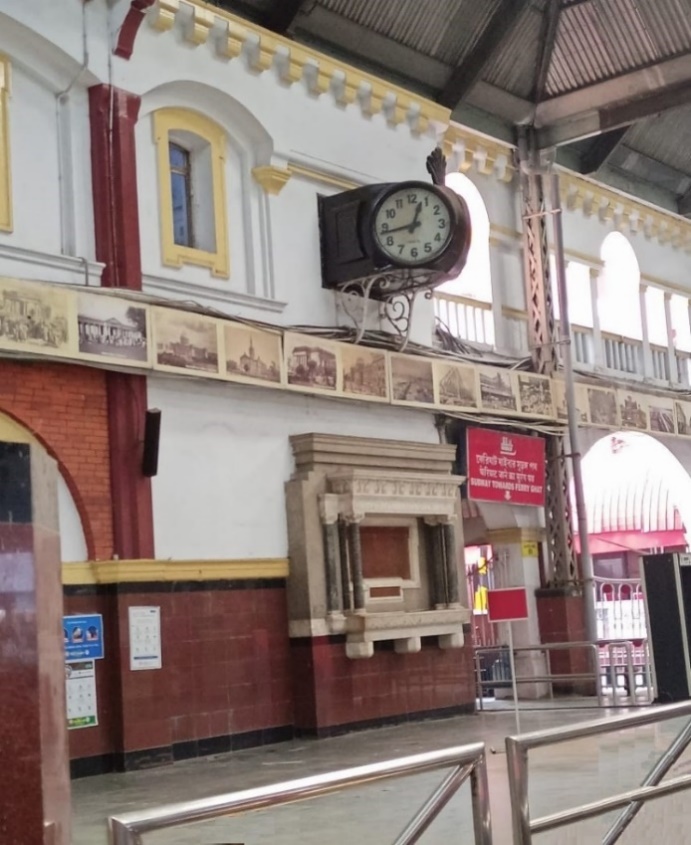 The British made double-faced clock - This clock of 1928 in the concourse has unerringly clocked 90 years of time keeping at one of the busiest railway stations in the country. The locational uniqueness of the clock (between the platform 8 and 9 close to the entry point of the Cab road)) serves as a meeting point in this era of smart phones and Google maps. The clock has stood the test of time and silently witnessed many faces who have waited below it .
There is another giant dual-faced clock of matching age at Howrah station mounted on one of the station’s towers outside , with one dial facing the Hooghly river. To recreate the past, we enjoyed ferry ride between Howrah ghat and Fairlie ghat and relished the unique experience of travelling on a dense waterway against the backdrop of the iconic Ravindra Setu. I recalled how on some occasions I had just escaped missing my train at Howrah station by deserting my road vehicle caught in traffic snarl on the busy Strand road and boarding the ferry at Fairlie ghat for Howrah ghat
New market (old name Hogg’s market) – Actually it is a 19th century enclosed market with its entrance at the Lindsay street The historic market today is a crowded, chaotic (specially during festivals) and colourful upscale market with a maze of shops and stalls-all under one roof. Visit. to this market filled us with emotions.
Gariahaat- Situated on Rash Behari avenue it is a major shopping attraction in south Kolkata. In the long stretch of shops, stalls & restaurants in all the four directions there is nothing one cannot get from here. We remembered this place for purchase of traditional Taant saris, artificial ornaments, garments and components of doll. The Taant sarees are intricately woven using a slew of native motifs such as floral paisley (curved tear drops), elephants, stars etc. We became nostalgic to enter some of the shops we had cherished during our Kolkata days .
Kolkata tram- Witnessing its beginning in the early 20th century Kolkata today nourishes the oldest tram network in the country. It had its hey days in early fifty when the network stretched from Howrah to Kolkata. I remember as probationer in 1963 I travelled between Howrah station and the Esplanade a number of times. Sadly, over the years the network shrank gradually on the perceptions that they had become outdated and occupied too much of road space. A trip to Kolkata is never complete without a tramcar ride across the city. I was delighted to hear the rumbling sound and the distinctive bell of the tram cars passing at Gariahaat.
Reminiscing railways- As a railway personnel I will always cherish the aesthetics & architecture of the spacious buildings with brick-red walls and tiled-roof in old railway settlements, quirks of life in the residential colonies, the focal points of the social life viz Institutes & clubs, memories of sight-sound-smell of a steam loco, the semaphore signals, the water column, the booking clerk punching date on the card ticket, the lampman ascending the steel ladder at a latticed signal post to light the lamps, the cabin with a colourful array of levers, the cabinman waving flag to a passing train, the guard blowing whistle and waving green flag/hand signal lamp to the driver, the gate-keeper standing alert at the level crossing with the hand signal flags duly wrapped, the driver exchanging token with the station staff and the family ambience of the railwaymen at a wayside station. Some have become redundant while the days of others are numbered. Many who have faint memory of steam days or have never seen a steam train, are thrilled by joining periodical steam excursion offering a nostalgic journey into the past, often associated with tourist attractions. Steam locomotives and vintage coaches evoke a sense of history and traditions. Visiting rail museums, heritage galleries & heritage parks also evoke nostalgia. Under the aegis of the heritage directorate of Railway Board a slew of measures, such as upgrading rail museums, promoting rail heritage tourism, additional steam trains, compilation of heritage inventory and publishing it on the website ,have got under way to institutionalize rail heritage preservation. However the older generation, who have witnessed the romance of railway of earlier century, is sometimes subjected to emotional distress and express their dismay through the following observation :-
“It is magnificent but it is not the railway”.